 English
 中文简体
中文简体
Home / News / Industry News / Knit vs. Woven Structures in 4 way stretch polyester fabric: Balancing Performance and Durability
Industry News
Content
The structure of 4 way stretch polyester fabric plays a critical role in the performance of high-strength outdoor clothing. Both knit and woven structures offer unique advantages in stretch, tear resistance, and snag/pilling resistance, which are crucial for durable sportswear and technical apparel.
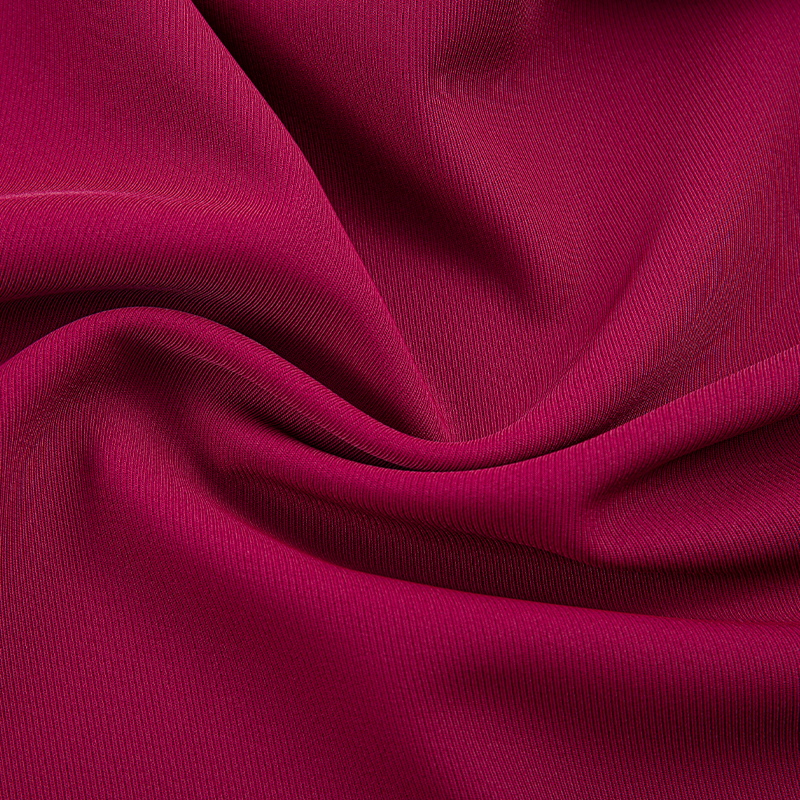
High-elastic polyester stretch knit fabric provides superior elasticity, conforms to body shapes, and ensures comfort during active movement. Compared to woven fabrics, knits have faster stretch recovery and more uniform tension distribution.
Knit fabrics can exhibit lower tear resistance due to their looped construction, which may slightly compromise durability in abrasive or high-intensity environments.
Snag-resistant polyester stretch fabric techniques such as tighter loops and filament yarns can reduce snagging, but knits remain more prone to surface damage compared to woven fabrics.
Woven 4 way stretch polyester fabric typically relies on mechanical or elastomeric yarns to achieve stretch. While less elastic than knits, woven fabrics provide excellent dimensional stability, crucial for structured outdoor garments.
Interlaced woven yarns deliver higher tear resistance, making woven fabrics ideal for abrasion-heavy applications.
Pilling-resistant 4 way stretch polyester fabric woven structures exhibit lower susceptibility to surface damage compared to knits, enhancing longevity.
| Property | Knit | Woven |
|---|---|---|
| Stretchability | High | Medium (requires elastomeric yarn) |
| Tear Strength | Medium | High |
| Snagging Resistance | Medium | High |
| Pilling Resistance | Medium | High |
| Comfort | High | Medium |
This table compares knit and woven 4 way stretch polyester fabric for key properties, helping engineers and product designers choose the optimal structure for outdoor garments.
| Property | Knit Fabric | Woven Fabric | Recommended Application |
|---|---|---|---|
| Comfort | High – conforms to body, excellent mobility | Medium – more rigid, less conforming | Knit zones for areas needing high flexibility (shoulders, elbows) |
| Stretchability | High – natural 4-way elasticity | Medium – requires elastomeric yarns for multi-directional stretch | Knit for mobility, Woven for structural support |
| Tear Strength | Medium – looped structure limits tear resistance | High – interlaced yarns improve resistance to ripping | Woven for abrasion-prone sections like knees, seat areas |
| Snagging Resistance | Medium – higher risk of loops catching | High – interlaced yarns reduce surface damage | Woven for outer layers or high-contact areas |
| Pilling Resistance | Medium – prone to fuzz formation on surface | High – smoother surface, less fiber migration | Woven for longevity, Knit acceptable for stretch zones |

Phone: +86 18806251599
TEL: +86 0512 63062555

Address: No. 1788, Yuanqu Road, Shengze Town, Wujiang District, Suzhou City, Jiangsu Province, China